
Advancing surface-selective doping of nanoparticles for solar H2
© 2026 EPFL
LIMNO researchers uncover rapid surface rearrangement mechanism for nanoparticle doping and demonstrate its importance for photocatalysis
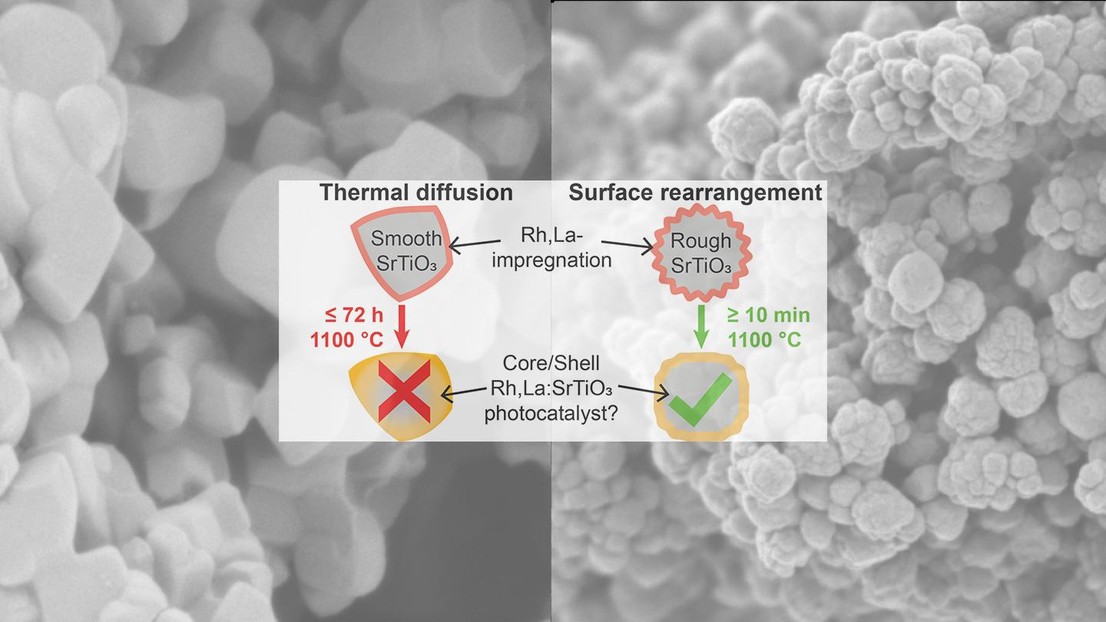
Our PhD student Melanie Johanning and project student Mara Blöchlinger have uncovered a highly effective mechanism for the surface-selective doping of nanoparticles. Their work shows that these nanomaterials undergo rapid surface rearrangement at high temperatures, enabling dopants to be incorporated faster and more controllably than previously reported.
The team investigated strontium titanate co-doped with rhodium and lanthanum (Rh,La:SrTiO3), a promising photocatalyst for hydrogen production. While surface-selective doping has previously produced some of the best-performing Rh,La:SrTiO3 nanoparticles, the mechanism behind this synthesis approach remained poorly understood. In the conventional method, SrTiO3 is mixed with dopant precursors and annealed for several hours at 1100-1200 °C. Researchers generally assumed that the dopants were incorporated through thermal diffusion driven by concentration gradients, despite diffusion being expected to proceed only very slowly under these conditions.
By comparing two different SrTiO3 starting materials, the LIMNO researchers discovered that dopant incorporation is instead driven by a rapid rearrangement of the nanoparticle surface during annealing. This process enabled surface-selective doping within just 10 minutes, whereas diffusion-based approaches did not produce suitable doping even after 72 hours.
The surface-rearrangement route not only dramatically accelerated the synthesis but also improved the performance. Rh,La:SrTiO3 prepared through this mechanism achieved hydrogen production rates six times higher than material synthesized using the conventional diffusion-based approach.
The findings, now published in the Journal of Materials Chemistry A, provide new insights into the controlled design of core-shell doped Rh,La:SrTiO3 and could enable rapid surface-selective doping strategies for a wide range of other materials.