
Advancing layered perovskites with a secondary spacer approach
© 2026 EPFL
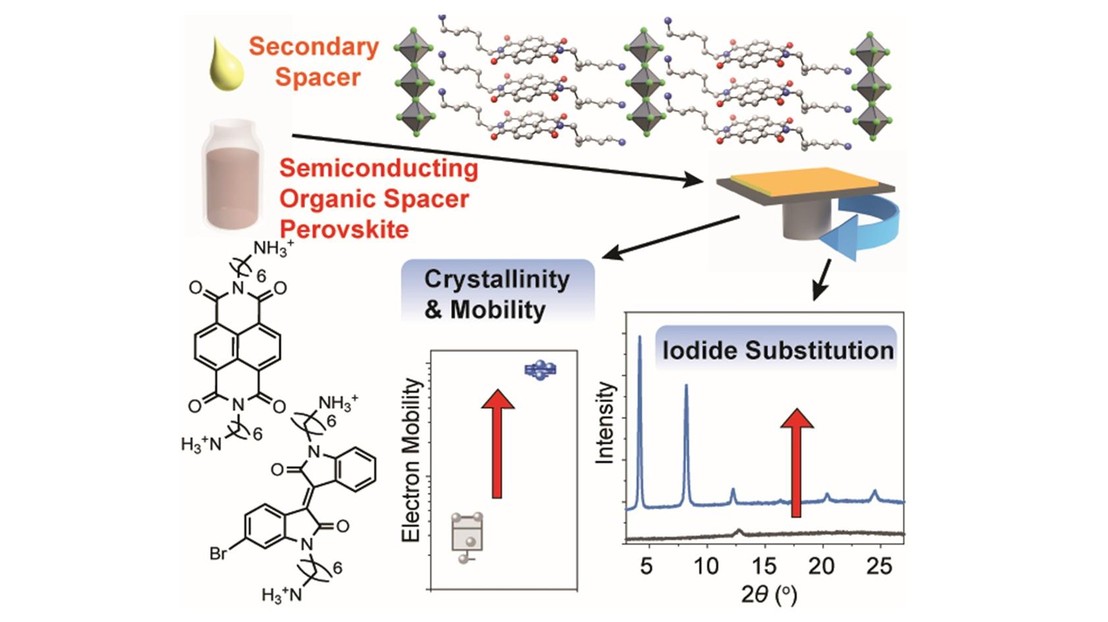
Congratulations to Waygen and fellow LIMNO researchers for their paper published in ACS Materials Letters! Their work introduces a generalizable method to incorporate bulky, high-performance organic semiconductors into layered perovskites while maintaining high crystallinity, overcoming a long-standing challenge in the layered perovskite community.
Our postdoctoral scientist, Waygen Thor and colleagues at the Laboratory for Molecular Engineering of Optoelectronic Nanomaterials (LIMNO) at EPFL have developed a groundbreaking strategy to integrate bulky, high-performance organic semiconductors into layeredperovskites. This new method, termed "secondary-spacer-assisted-method," addresses a major bottleneck in materials science: the difficulty of packing large, charge-transporting molecules into the rigid structure of lead-halide perovskites without sacrificing the material's quality and performance.
Layered perovskites, often called "2D perovskites", consist of alternating organic and inorganic layers. Scientists have long sought to replace traditional small organic molecules in these layers with larger, semiconducting ones to create highly tunable materials for next-generation solar cells, LEDs, and transistors. However, these "bulky" molecules typically struggle to fit correctly, resulting in materials with poor crystallinity.
LIMNO team discovered that adding a small "secondary" organic molecule to the mix acts as a powerful molecular assistant. This smaller secondary molecule, such as phenylethylammonium (PEA+), surprisingly does not form its own separate material phase. Instead, it promotes the formation of tiny "seeds" in the precursor solution that guide the larger semiconducting molecules into a highly ordered and crystalline framework.
By using this approach, the researchers achieved a nearly ten-fold increase in the material's charge carrier mobility, which is critical for efficient electronic devices. Furthermore, the method allows for the use of fragile semiconducting molecules that would otherwise break down during standard fabrication processes. This breakthrough was demonstrated by successfully incorporating a complex isoindigo-based ligand into a layered perovskite for the first time.
This generalizable strategy offers a versatile route for scientists to design new hybrid materials, combining the best properties of organic semiconductors with the high-performance potential of layered perovskites. The work paves the way for more efficient optoelectronic technologies that can be tailored with molecular precision.