
Accurate indoor localization using distributed sensing
© 2013 EPFL
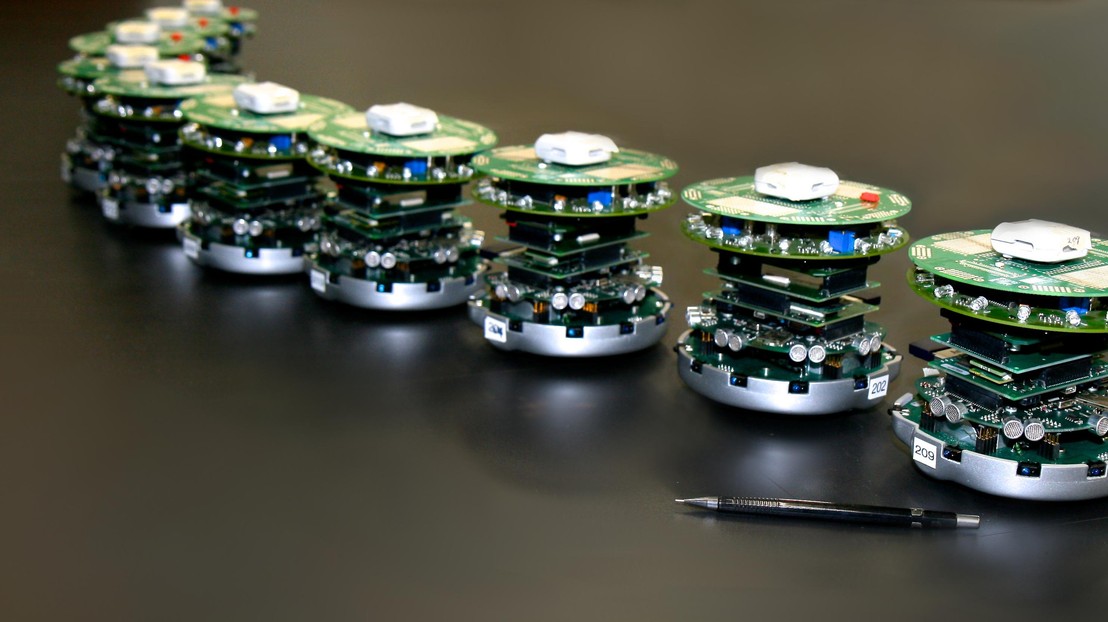
Researchers Amanda Prorok and Alexander Bahr working with Alcherio Martinoli have developed a way to localize objects indoors where GPS systems perform poorly.
They tested their solution on a population of robots that were let loose in a room scattered with everyday obstacles – chairs, tables, boxes – as well as custom-made obstacles made of all sorts of materials. Each robot was equipped with an emitter that sends out nano-second pulses of radio signals (so called impulse-radio ultra-wideband), which were captured by receivers in all four corners of the room, allowing the researchers to pinpoint its location by triangulation. Commercially available indoor localization setups perform well as long as the robots never leave the line of sight of the receivers, but the presence of a metal obstacle can be enough to dramatically skew the results. The solution developed in Martinoli’s group accurately locates the robots even when obstacles block the line of sight, by having the individual robots share information and by using numerical algorithms to compensate for the signal distortion caused by the obstacles. Potential commercial applications include inventory tracking, asset management and assembly control.