
A new look at ultrathin materials
© 2011 EPFL
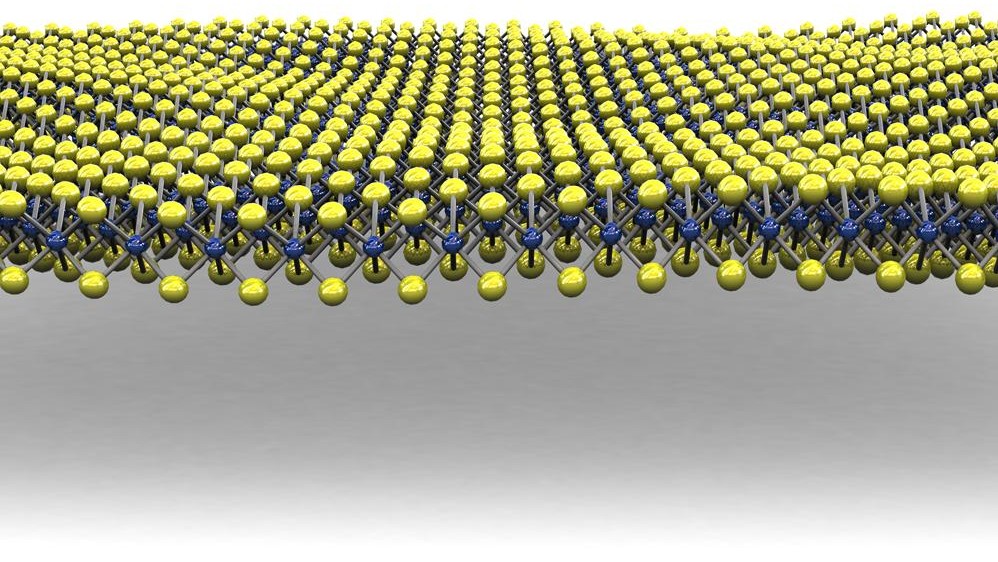
What do ultra-thin materials look like? New results published in the journal, Nano Letters, show that single layers of a new semiconductor, MoS2, have a highly regular crystalline structure with ripples that can help explain their electronic properties.
Molybdenum disulphide (MoS2) is commonly used as a lubricant and can be separated into individual layers similar to graphene. The difference is that MoS2 has a band gap, which has recently allowed Prof Kis' group to show that single layers of MoS2 can be used as a new semiconductor in transistors with a potential for extreme power efficiency. (Nature Nanotechnology, 2011).
The group has now reported in the journal Nano Letters (doi: 10.1021/nl2022288), the production of freestanding MoS2 membranes which allows studying this material without the influence of the support. Jacopo Brivio, a Ph.D. student in the group, used the membranes to study the structure of this unique material on the atomic scale in collaboration with Duncan Alexander from the Interdisciplinary Center for Electron Microscopy (CIME) at EPFL. This is the first time that ultra-thin MoS2 with a known number of layers was studied using an electron microscope. The scientists found that this material contains small ripples that can increase the electrical resistance and hope that by removing them they will be able to further improve the electronic properties. This finding will allow MoS2 transistors with higher performance to be produced in future. The membrane fabrication method is also a valuable tool that will allow different measurement techniques to be combined on the same piece of the nanomaterial.