
A laser that stays locked without active control
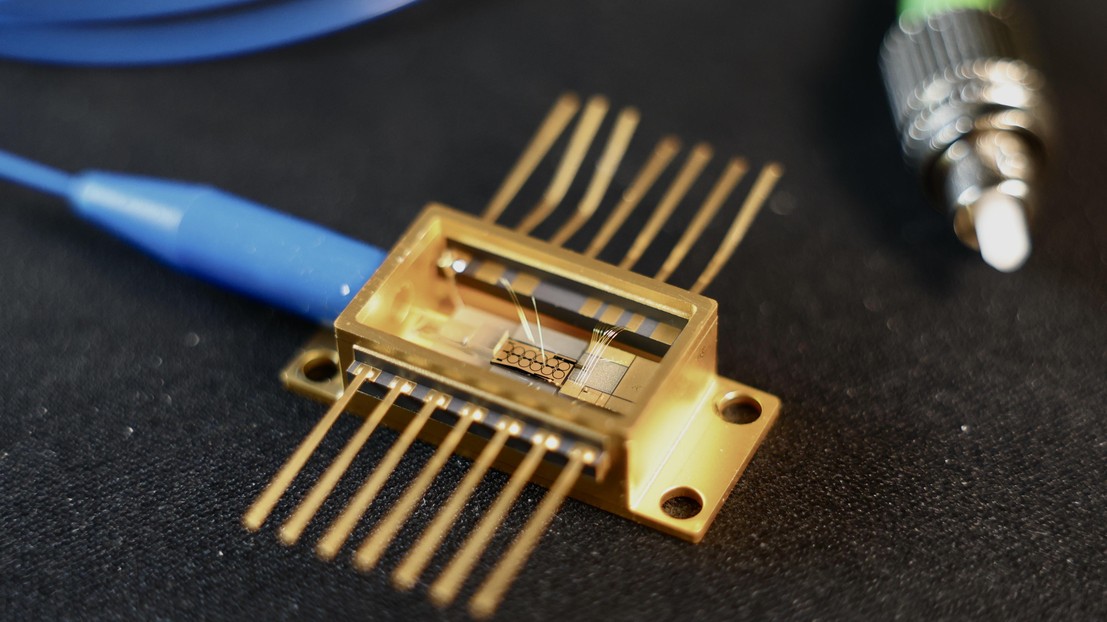
Photonic integrated endlessly self-injection locked laser assembled in a fiber-coupled standard butterfly package. 2026 EPFL/Simone Bianconi - CC-BY-SA 4.0
EPFL researchers have developed a chip-based laser that keeps a very stable frequency across its tested operating range, without needing active electronic control.
Lasers provide the precise light needed for atomic clocks, quantum sensors, fiber-optic monitoring, coherent communications and distance measurements. These applications depend on lasers whose optical frequency remains exceptionally stable. The most precise systems often rely on bulky laboratory lasers, which limits their use in compact and portable technologies.
Semiconductor lasers offer a practical alternative. They are small, electrically powered and suitable for large-scale manufacturing. Their frequency, though, tends to fluctuate much more than that of the fiber lasers used in precision systems.
Researchers can reduce this noise through self-injection locking. In this approach, part of the laser light enters a high-quality optical resonator and returns to the laser. This optical feedback stabilizes the laser frequency and can narrow its linewidth, a measure of frequency stability, by several orders of magnitude.
The challenge is keeping the laser stable in this state. It usually only works under very specific conditions, such as a particular electrical current and an exact path length phase of the returning light. Small changes, like temperature shifts or tiny variations from manufacturing, can easily disturb this balance. Because of this, most systems need extra controls and electronics to constantly adjust the laser and keep it stable.
A team led by Tobias J. Kippenberg at EPFL has now demonstrated a photonic integrated laser that remains self-injection locked across its tested drive-current range. The researchers call the approach “endless self-injection locking”.
The device combines a standard semiconductor laser with a tiny optical chip that feeds some of the light back into it. By carefully designing this feedback, the team ensured the laser stays stable even as conditions change.
They also made the stable operating regions overlap. This means that as the drive current changes, the laser can smoothly move between stable states without losing its lock.
The researchers tested the laser while varying its drive current from 154 to 300 milliamps. At every measured current, self-injection locking reduced the frequency noise by more than a factor of 5,000 compared with the free-running laser. The intrinsic linewidth stayed below 10 hertz.
The team also integrated piezoelectric actuators onto the photonic chip. These actuators tune the resonator through the stress-optic effect when voltage is applied. The device produced mode-hop-free frequency chirps of over 1.5 gigahertz while remaining locked, without active control of the drive current or feedback phase.
The design could make compact, ultra-low-noise lasers easier to operate in applications such as optical sensing, LiDAR, coherent communications, atomic clocks and quantum sensing. The work demonstrates the principle in a laboratory device. Further engineering and packaging would be needed for deployment outside the lab.
Other contributors
- EPFL Institute of Electrical and Micro Engineering
- EPFL Advanced NEMS Laboratory
Horizon Europe EIC Transition programme (FORTE)
Marie Curie Doctoral Network (MicrocombSys)
Swiss State Secretariat for Education, Research and Innovation (SERI)
Mikael Reichler, Simone Bianconi, Yichi Zhang, Marco Liffredo, Luis Guillermo Villanueva, Tobias J. Kippenberg. Endlessly self-injection locked photonic integrated lasers. Nature Photonics 28 September 2026. DOI: 10.1038/s41566-026-01985-1