
A $3 million Endeavor Grant for cross-disciplinary cancer research
2026 EPFL CC BY SA 4.0
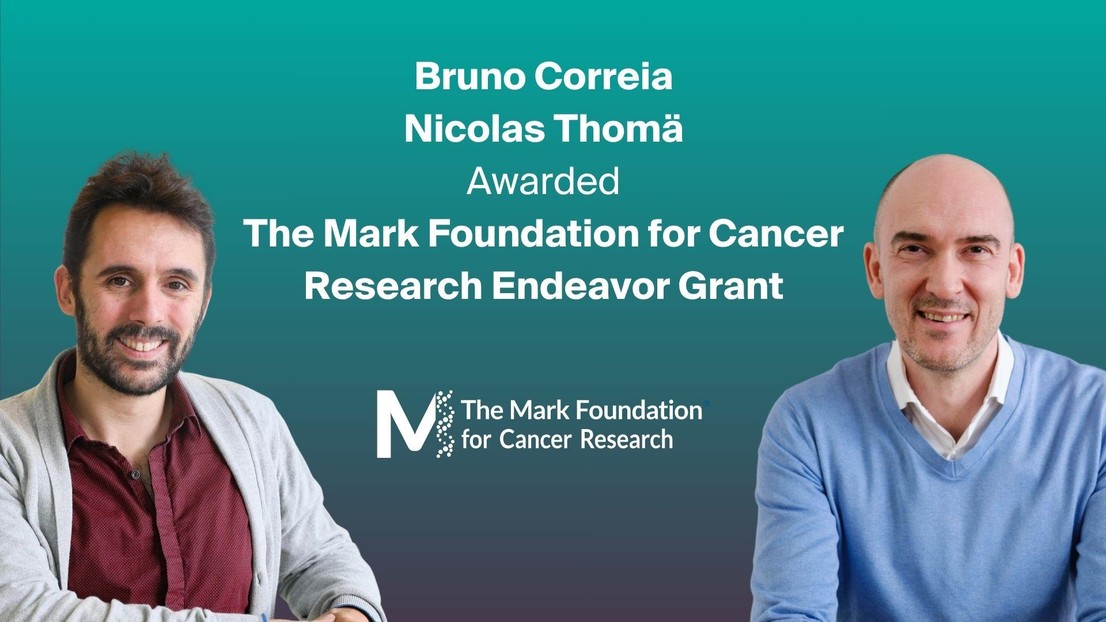
The Mark Foundation for Cancer Research has awarded $12 million across four Endeavor Grants to support cross-disciplinary cancer research. One grant has been awarded to a multi-institutional team including School of Engineering professor Bruno Correia and School of Life Sciences Professor Nicolas Thomä.
The Mark Foundation for Cancer Research, a charitable organization based in New York City, actively partners with scientists worldwide to accelerate research that will transform cancer prevention, diagnosis, and treatment. By giving collaborative teams the financial freedom and operational flexibility to explore complex challenges through diverse lenses, the three-year, $3 million Endeavor Grants enable global experts to integrate distinct technologies and significantly accelerate the path from laboratory discovery to active clinical treatment.
This year, Bruno Correia, head of the Laboratory of Protein Design and Immunoengineering, received a grant alongside fellow EPFL professor Nicolas Thomä, Paternot Chair of Cancer Research in the School of Life Sciences, and Nathanael Gray of Stanford University. The project is led by Georg Winter of Austria's AITHYRA Institute.
Their project, Blocking Oncogenic Transcription via Ligand-Triggered SUMOylation (BOLTS), focuses on the overactive transcription factors that drive many of the most aggressive cancers. These master control switches that cause tumor cells to divide uncontrollably. Historically, directly targeting these switches with therapeutic agents has been deemed impossible because they constantly change their shape and lack the deep structural pockets to which traditional drugs bind.
The project was born from an accidental discovery. While studying an existing class of breast cancer therapeutics called SERDs (Selective Estrogen Receptor Degraders), the team realized that those drugs weren’t directly destroying their targets as previously thought. Instead, they were triggering a natural cellular process called SUMOylation. This process acts like a biochemical padlock, physically freezing the shape-shifting cancer switch onto the cell’s DNA and rendering it completely silent.
Uniting the disciplines of chemical biology, biophysics, and AI-enabled structural biology across research labs in Austria, Switzerland, and the United States, the team is building a pipeline to intentionally design new, drug-like padlocks. Rather than destroying these elusive transcription factor targets, these new drugs will freeze them in an “off” state—silencing notorious cancer drivers in treatment-resistant prostate, pancreatic, gastric, and brain cancers.