“Teachers, like storytellers, know how the story ends”

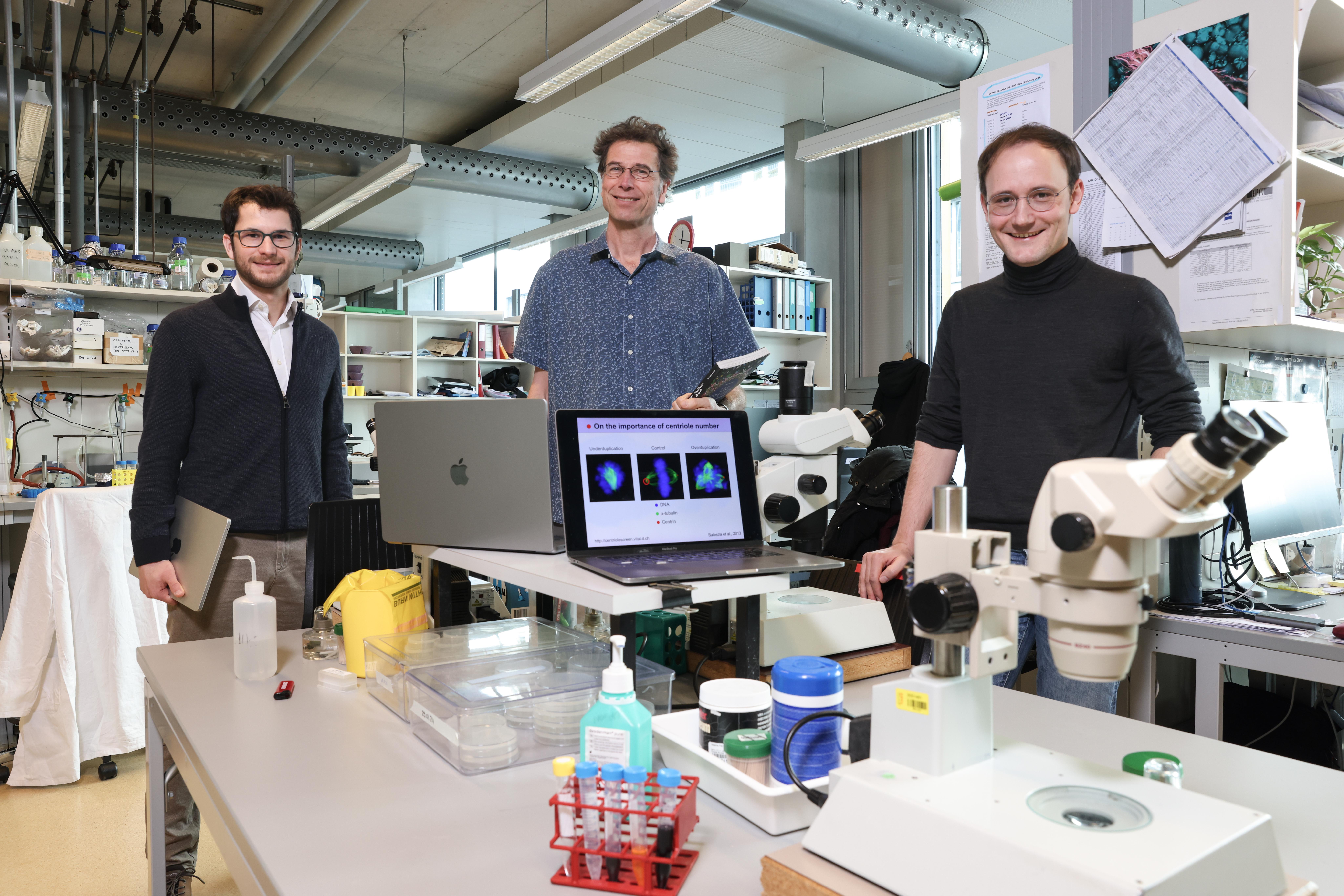
Pierre Gönczy teaching a class of cell and developmental biology, Credit: Titouan Veuillet (EPFL) - EPFL/Titouan Veuillet - CC-BY-SA 4.0
Pierre Gönczy got his first taste of teaching by giving math lessons to junior-high students – a job he took to pay for a gap year devoted to photography. He considers it a privilege to be able to impart knowledge to students, regardless of their age. Gönczy was recently named the best teacher in the life sciences section for 2024.
“A lot of fun, and it all came pretty easily to me,” says Gönczy, describing his time as a biology student at the University of Geneva. “But that’s not to say my classes weren’t interesting – on the contrary,” he adds. The material “made so much sense” and he “enjoyed the lectures so much” that the classwork hardly felt like work.
However, obtaining his degree was no walk in the park. Gönczy recalls “spending an entire month studying a 1,000-page biochemistry textbook!” After graduating, he went to Rockefeller University for his PhD, which he found just as enjoyable – “especially since I loved New York City.”
The light-bulb moment
Gönczy completed his thesis in 1995 on the molecular genetic analysis of spermatogenesis in drosophila and then took a postdoc position with the European Molecular Biology Laboratory in Heidelberg, Germany, to study the mechanisms of cell division. “That’s when I found my true research calling,” he says. “I wanted to explore how cell division architecture is planned and executed within the cells themselves.” In 2000, Gönczy returned to the Lake Geneva area, taking a position at the ISREC cancer research foundation. “My tenure case was transfered to EPFL four years later, where I had the opportunity to help grow the life sciences department.”
His role at EPFL also included teaching, but that wasn’t a problem for the young scientist. “I took a gap year before starting my PhD so I could focus on photography, open a gallery and write a few articles for a magazine,” says Gönczy. “I paid for that year by teaching math at a junior-high school.”
Yet his affinity for explaining things to others dates back even earlier, to when Gönczy himself was in junior high. “I held tutoring sessions for other students – and I loved it!” he says. He still remembers “those amazing light-bulb moments when someone finally got a concept and I could see their face light up.”
Chocolate bars and portable microscopes
Gönczy was appointed as an associate professor at EPFL in 2005 and as a full professor in 2009. Today he heads EPFL’s Cell and Developmental Biology Lab. Over the years, the range of classes he’s taught (or co-taught) has changed, but one thing has stayed the same – his highly interactive teaching style and priority on getting students involved.
Gönczy does that by drawing on unconventional teaching methods, such as pop quizzes on theory with chocolate bars handed out as prizes, group assignments focused on specific topics, and field trips to the Sorge river to collect samples of living organisms and analyze them with portable microscopes the students make themselves in class. “When I’m teaching a particularly large class, I make a point of maintaining contact with the entire classroom by walking among the students and asking them questions directly,” he says. “For me, giving an hour-long monologue is simply out of the question.”
A little like a storyteller
“When I prepare my lectures – generally in conjunction with the professors I co-teach with – I structure them so that students also have an opportunity to learn transferable skills.” These skills include the capacity to critically read and discuss articles from scientific journals. “It’s an essential skill for scientists and engineers, whether they work in industry or academia,” says Gönczy. He believes EPFL students aren’t given enough exposure to the scientific literature and aims to remedy that. “I also try to activate students’ brain cells as much as possible during my lectures and spark their creativity. Research in educational science has shown that students learn better this way.”
“I view teaching as a privilege,” he adds. “Sometimes I feel like a village storyteller who people listen to attentively to find out how the story ends.” Gönczy feels it’s important to continuously improve the quality of scientific education in Switzerland and make it more inclusive. As part of these efforts, he helped put together the EPFL Immersion Week – a pilot program for teachers of years 7 and 8 in the public school system. The Immersion Week was introduced in the fall of 2024 and includes classes on specific topics as well as experience in an EPFL lab, all with the goal of improving citizens’ scientific reasoning skills. “At the end of the day, that’s what will keep our democratic system on track.”