
Fano resonances: retrieving the underlying modal structure
© 2014 EPFL
The optical properties of plasmonic nanostructures supporting Fano resonances are investigated with an electromagnetic theory. Contrary to the original work of Fano, this theory includes losses in the materials composing the system. As a result, a more general formula is obtained for the response of the system and general conclusions for the determination of the resonance parameters are drawn. These predictions are verified with surface integral numerical calculations in a broad variety of plasmonic nanostructures including dolmens, oligomers, and gratings. This work presents a robust and consistent analysis of plasmonic Fano resonances and enables the control of their line shape based on Maxwell’s equations. The insights into the physical understanding of Fano resonances gained this way will be of great interest for the design of plasmonic systems with specific spectral responses for applications such as sensing and optical metamaterials.
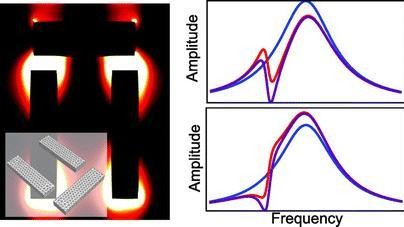
In plasmonic systems, Fano resonance originate from the interaction between a bright and a dark mode. Using our recently developed ab-initio formalism, we demonstrate that the underlying modal structure can be easily retrieved for a broad variety of experimental plasmonic systems. Some of these systems are illustrated in the following figure and include dolmen-structures, heptamers, double gratings, gratings and waveguides, etc... .

This study provides a very comprehensive analysis of the mechanisms that lead to Fano resonances in plasmonic systems and addresses the figure of merit associated with different geometries. The following figure explains the mechanisms that lead to Fano interferences in a plasmonic system.

a) Mechanism of Fano-like interferences between a resonant dark mode with complex resonance frequency ωd+iγd and a flat continuum of radiative waves. Two pathways have to be considered: the direct excitation of continuum and the excitation of the dark mode through its coupling to the continuum. The frequency-dependent phase difference between the direct and indirect pathways leads to both a destructive and a constructive interference. The resulting line shape modulates the continuum and satisfies Eq. (1) developed in the paper given below, where ωa is the Fano-like resonance frequency, Wa is its spectral width, q is the asymmetry parameter, and b is the modulation damping parameter. (b) Fano-like interference between a resonant dark mode and a bright mode.
Check the corresponding publication: PDF External link: doi: 10.1021/nn203173r