News Mediacom

Tiny new tool to track heart rate in real time on a smartphone

19.10.11 - Thanks to an invention from two EPFL laboratories, patients and their doctors can now immediately be made aware of heart rate anomalies and can thus quickly take any necessary medical measures. The device is very small, non-invasive and equipped with long-lasting batteries.


Detecting the onset of cardiac anomalies at a very early stage: this is the goal of a new device developed by researchers in EPFL’s Embedded Systems and Telecommunications Circuits Laboratories. Heart disease is the number one cause of death worldwide; according to World Health Organization statistics, it is responsible for 70,000 – 100,000 sudden deaths every year. In heart attack situations, time is of the essence in preventing death.

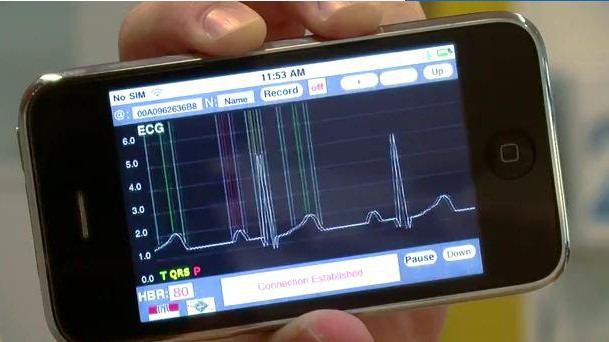
This new tool is one of a new generation of embedded systems that are intelligent and autonomous; as they monitor human biological systems, these so-called “wireless body sensor networks,” (WBSN) consume very little electricity. They’re made up of high-precision body sensors applied to the skin, a ZigBee radio module and a chip that’s optimized for analyzing and processing biological signals.

They’re miniaturized, so everything is light and non-invasive. Connected to a wireless network, they monitor users’ heart rates remotely and in real time. By means of complex algorithms, anomalies can be detected and analyzed. When a problem is detected, information is sent to the user’s smartphone, then by text message or e-mail to medical personnel, who can intervene if necessary.

“This system collects very reliable and precise data, it’s equipped with a very effective noise filtering system, and it has batteries that can last for 3-4 weeks at a time,” notes EPFL professor David Atienza, head of EPFL’s Embedded Systems Lab. “Above all it provides an automatic analysis and immediate transmission of data in compressed format to the doctor, preventing him or her from having to work through hours of recorded data.”

“Its size, its lightness, its ease of use, the fact that it measures continuously and remotely, which allows analysis to take place anywhere, makes this device very attractive to doctors,” says Etienne Pruvot, a cardiologist in the Lausanne University Hospitals (CHUV) Cardiology Service, who adds that the system still needs to be tested in real-life conditions.

According to Atienza, other applications, such as monitoring athletic performance, are also possible. Researchers are looking into a project that would monitor diet and physical activity in obese patients (PRONAF: www.pronaf.es - in Spanish).

Various collaborations with companies are underway, such as a European project named IcyHeart which has just begun. Its goal is to design an ultra-compact, non-invasive system that could monitor a variety of health indicators in a completely autonomous fashion, remotely and cheaply. This new tool is also part of the vast “Guardian Angels” research project, whose goal is to develop personal assistance devices that would help people manage health and quality of life over an entire lifetime.

Return to previous page
Alumni
Olivier Glauser
Diplôme
Master en Informatique et systèmes de communication 1994
Parcours
1994 - 1996 HP
1996 - 1998 Phillippe Moris
1998 - 2005 MBA Universite de Harvard
2005 - 2009 ROTH Cl Partners
Fonction
Directeur général de Streamboat Ventures, Pékin

Contacts

Olivier Gauser
Steamboat Ventures
222 Hu Bin Road, Shanghai 200021
Tel: 86 (21) 2308 1800
olivier.glauser@steamboatvc.com
A3 EPFL
Rolex Learning Center
Case postale 122
1015 Lausanne 15
Tel: +41 (0)21 693 24 91