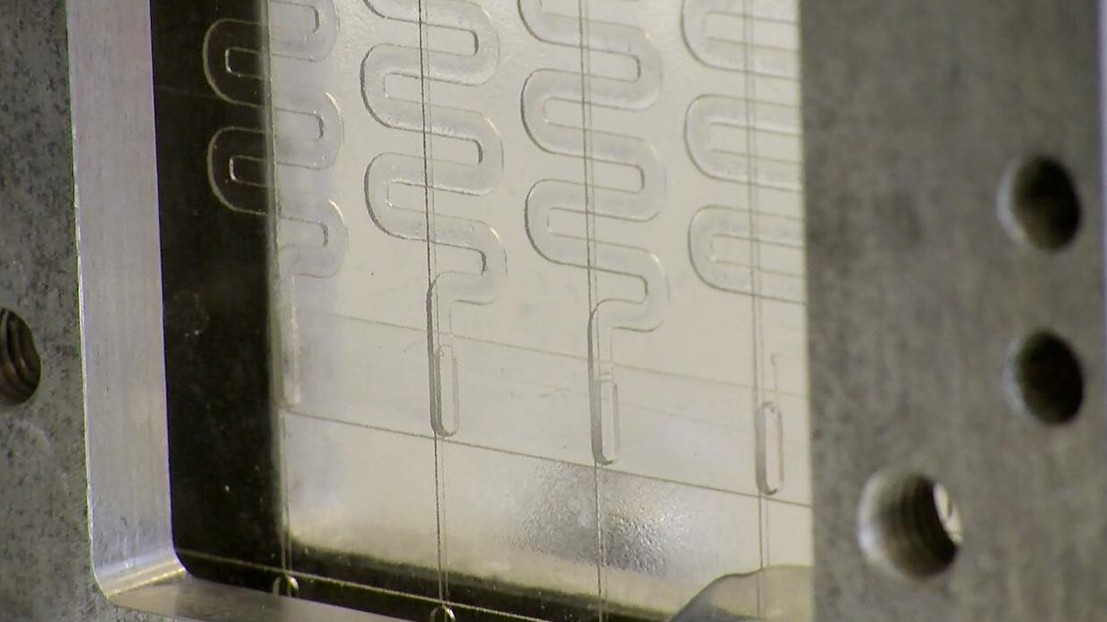
The equipment being developed by EPFL’s Group of Catalytic Reaction Engineering (GGRC) will soon make it possible to manufacture drugs and household products in a safer and more efficient manner. The scientists have come up with a new kind of microreactor for industry that reverts how chemical reactions are done on a large scale.
When fragrance or flavor molecules, drugs and intermediates used for perfumes, creams, shampoos and other similar products are manufactured, the chemical reactions involved typically take place in big, agitated containers called reactors. The various ingredients are mixed in the container, often along with catalysts that increase the reaction speed, while temperature, pressure and a variety of other parameters are carefully controlled. These reactors are usually quite large (several cubic meters in volume) in order to be able to produce large quantities of a product. They operate in discontinuous cycles, which mean they must be stopped, emptied and cleaned before each new use.
The GGRC team worked with the company Givaudan Suisse SA to rethink this process, and ended up taking a diametrically different approach – dividing up the substance into small volumes in order to produce it more efficiently. With their development, the chemical reaction doesn’t take place in big containers, but in micro-channels, each with a diameter of a few hundred microns. Several thousand of these channels can be assembled together.
Continuous production
“The primary advantage is a much higher level of safety,” explains GGRC director Lioubov Kiwi. “It allows us to perform rapid reaction under the conditions that cannot be reached in conventional equipments. Any problem or risk of explosion remains confined within a tiny volume. It’s also much easier to control the temperature and, in fact, the entire process. In addition, they function continuously, with reactants entering on one side of the micro-tubes and the final product is continuously generated at the exit.”
In terms of efficiency, the new equipment developed is advantageous because it reduces the loss of raw materials. “About 20% of raw materials, up to now wasted in this process, can now be recuperated,” the professor explains. In addition, the size of installations can be reduced by a factor of ten. Finally, the procedure improves product quality, because there are fewer impurities and waste products produced in the procedure.